
Biology and medicine
Geometric scaffolds for packing, growth, folding, implant design — and concrete navigation experiments.
Clean scaffolds for messy questions
Natural systems are full of packing, branching, growth, folding, and surface constraints — and they are conspicuously non-periodic. Aperiodic monotile patches are not biological models by default, but they are clean geometric scaffolds for asking better questions: what does growth on a structured-but-non-repeating substrate look like? How do cells or crystals pack when the template forbids periodicity?[6][13]
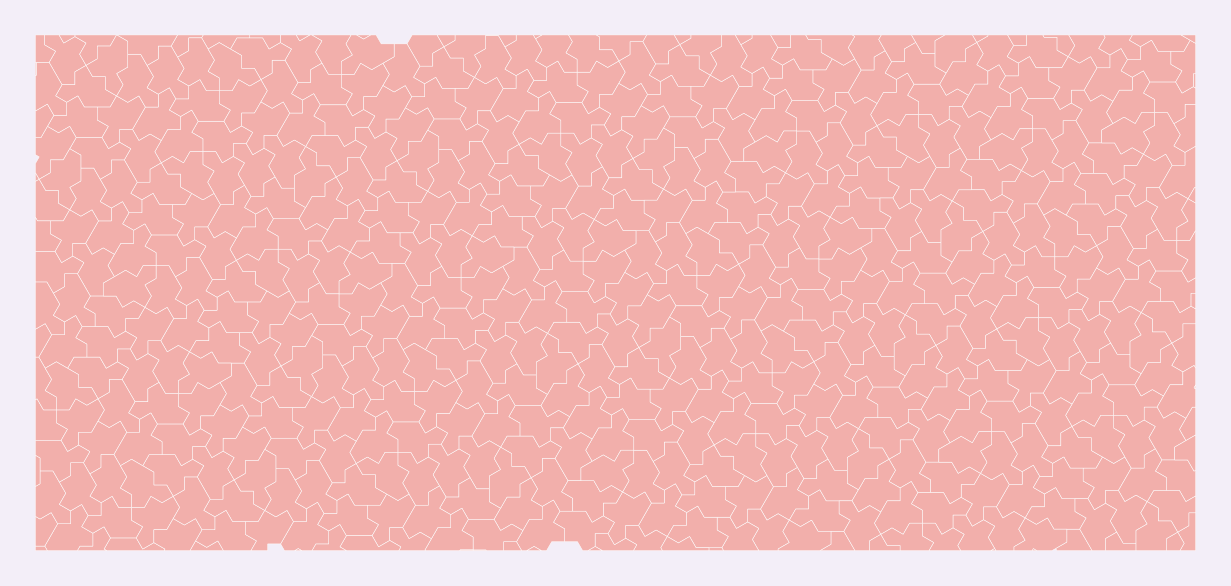
For implants and tissue scaffolds the mechanical argument mirrors materials science: aperiodic strut layouts avoid the aligned failure planes and resonances of periodic lattices while remaining fully specified for regulatory review — every strut position is deterministic and documentable.[2]
Suggested experiment: the aperiodic mouse maze
Spatial navigation labs already know that cue layout changes behavior: radial-arm mazes, Barnes mazes, and Morris water mazes carefully control distal landmarks because rodents (and their place / grid cell systems) exploit them. An aperiodic monotile floor or wall field is a stronger, still controllable intervention: every local patch is unique, so “same corridor, different place” is geometrically enforced — unlike a checkerboard or brick floor, where many local views are identical.
A concrete protocol sketch:
- Build two matched arenas of equal area and wall height — one with a periodic tile or grid floor, one with a Spectre / Tile(1,1) patch generated for the exact footprint (same tile count order of magnitude, same contrast paint).
- Train rodents on a goal location (food / escape / platform) with identical distal room cues in both arenas.
- Probe under cue conflict: rotate or shift a local floor region, or start the animal from a geometrically analogous but non-identical monotile neighborhood. Ask whether path efficiency, heading error, and re-orientation latency differ between periodic and aperiodic floors.
- Optional electrophysiology / imaging: compare place-field stability and remapping when the animal revisits a visually similar corridor that is not the same tile neighborhood (impossible to arrange cleanly on a periodic lattice).
The point is not that brains “use monotiles.” It is that monotile geometry gives experimentalists a regenerable, ID-addressable landmark field where uniqueness is a theorem, not a hope — the same reason robotics cares about aperiodic floors for localization.[72]
Other directions
- Morphogenesis, shell growth, protein folding, cellular packing, and neural geometry studies
- Implants, prosthetics, vascular stents, tissue scaffolds, and surgical planning
- Crystal nucleation templates, catalysts, zeolites, and molecular cage geometry
- Microfluidic channel layouts without periodic recirculation traps
- Behavioral arenas for insects and fish with regenerable aperiodic visual texture
See also
Materials science and fluids, Robotics and mobility, Education
Categories: Research frontiers